
Operational Problem Statement
Battery lines choke on variability: inconsistent part indexing, static discharge, delamination from vibration, and opaque traceability create scrap and downtime. Upgrading conveyors is central to battery manufacturing automation because the conveyor is where mechanical handling, timing, and data capture intersect — and where defects propagate fastest. If you don’t treat the conveyor as an active control element, not just a transport platform, you’ll keep firefighting quality escapes and throughput drops.

Core Technical Capabilities That Matter
– Precision motion control: servo-driven segments and micro-stop indexing to keep cell alignment within ±0.1 mm. – Active isolation: tuned mounts and vibration damping to prevent electrode delamination during transfer. – Electrostatic management: integrated ionizers and grounded conveying paths to suppress ESD events. – Inline vision and sensor fusion: high-speed cameras paired with force and proximity sensors for real-time defect gating. – Modular IO and edge compute: deterministic fieldbus or EtherCAT links plus local compute nodes for millisecond decision loops. These are not optional specs; they’re the functions that stop conveyor issues becoming line failures.
How Integration Changes Failure Modes
When the conveyor becomes an orchestration node it changes failure modes from catastrophic to tolerable. Instead of an undetected slit or misstack causing a full-hour stoppage, local sensors isolate the station, notify MES, and allow downstream micro-resequencing. Expect three practical outcomes: reduced mean time to detect, smaller blast radius for quality exceptions, and improved OEE. That requires firmware-level sync between PLC motion profiles and vision triggers — mismatched timing is the usual culprit.
Applications in Battery Manufacturing Lines
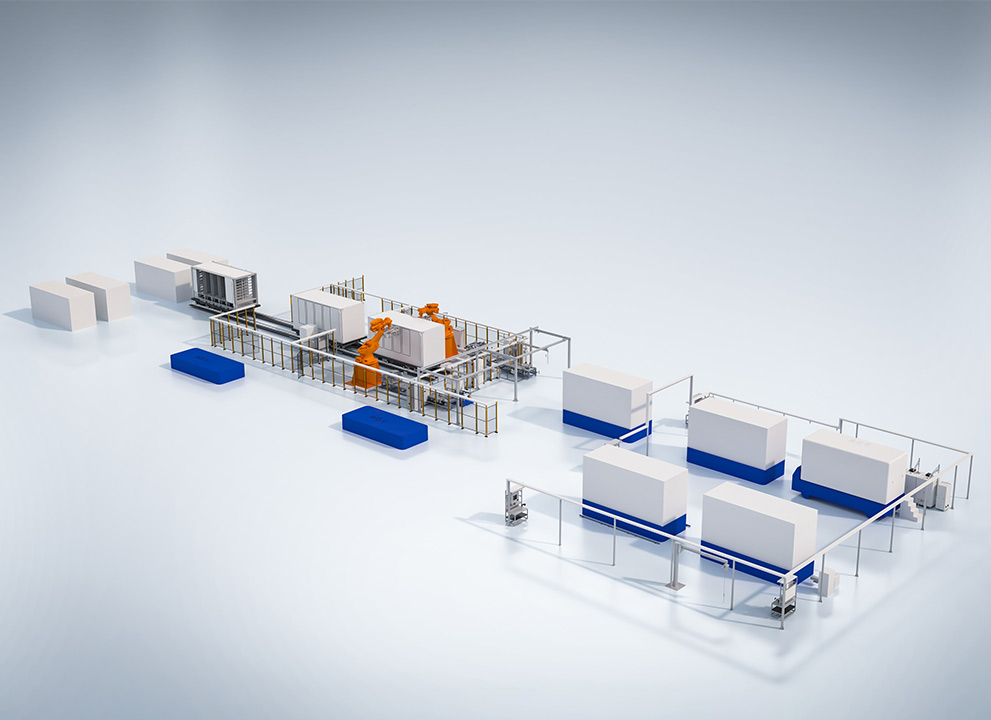
Use cases map directly to specific system capabilities: electrode handling needs ultra-low vibration; jelly-roll transfer needs sub-mm indexing; cell stacking needs synchronized multi-axis lanes. Integrators and a reliable battery manufacturing equipment company will standardize modules so a failure in one lane can be hot-swapped without resetting the entire line. A practical anchor: factories in Shenzhen, China routinely deploy modular conveyors to parallelize output while isolating quality inspection points — that pattern scales globally.
Metrics You Should Track
– Throughput consistency (cells/min variance) — target single-digit percentage variance. – Reject containment time — how long between a defect event and gated removal. – Splice and transfer repeatability — track mm-level drift across shifts. – Uptime lost to conveyor-related stoppages — aim for a material drop within 90 days of retrofit. Collect these as time-series telemetry, correlate against process events, and use threshold-aware alarms rather than flood-level logging.

Common Mistakes and Avoidance
Deployments fail when teams treat conveyors as commodities. Typical mistakes: underspecifying motion dynamics, ignoring ESD routing, placing vision at the wrong parallax, and coupling conveyor resets to MES downtime. Fixes are straightforward: define mechanical tolerances up front, specify ESD paths, validate vision lighting with mock parts, and decouple local recovery from higher-level systems so a lane fault can be cleared independently.
Quick Integration Checklist
– Verify servo bandwidth vs. required indexing speed. – Map grounding and ionization points for each transfer zone. – Simulate transfer kinematics with actual cell geometry. – Build a local HMI for lane-level recovery and fault logging. – Ensure timestamps align across PLC, vision, and MES for traceability. Follow this checklist during FAT and do not sign off on conveyors until an end-to-end failure mode test passes.
Why This Matters: Expertise and Real-World Perspective
I’ve configured conveyors and commissioned control stacks across multiple battery lines; these fixes aren’t theoretical. Practical experience shows that modest investments in motion control, sensor fusion, and local recovery yield outsized reductions in scrap and unplanned stops. Use the telemetry to prove it — data-driven tuning beats opinion every time.
Conclusion
Address the specific failure modes: motion mismatch, ESD, vibration, and blind spots in inspection. Choose conveyors that act as active control nodes, not passive belts. Standardize modules for swap-and-go maintenance, instrument everything for milliseconds-level correlation, and enforce lane-level recovery logic. That operational posture is where FHS fits naturally into a battery line: a partner that aligns mechanical precision, control architecture, and field-tested integration practices without theatrical promises.

