
Introduction — a Saturday that changed my checklist
I remember a Saturday morning on a job in Cleveland when a whole run of lights went dim right before brunch service — I swear you could see the customers glance up. I was hauling rolls of LED strips lights, the crew was short-handed, and the owner needed a quick fix that actually lasted. The data that week surprised me: nearly 28% of small-run exterior installs I audited in 2022 reported premature failures within the first six months. So what really causes that, and how do you stop buying the same headache twice?
That morning stuck because it forced me to rethink what I sell and what I recommend to wholesale buyers and small e-commerce owners. I’m over 15 years in commercial lighting supply, and I’ve learned that experience beats slick specs on a sheet. (I still keep the sticky note from that diner — old habits.) Read on — I’ll walk through the typical traps and practical fixes.
Part 1 — Why conventional fixes for exterior LED light strips often fail
Why do these strips fail so fast?
Look — I won’t sugarcoat it. Most installs fail for a handful of repeatable reasons. First, vendors push 12V SMD5050 60 LEDs/m tape into runs longer than the wiring supports. Voltage drop happens. You’ll see brightness fall and the end of the run die. Second, IP rating and sealing get ignored. A strip rated IP65 might survive rain, but if the connectors or the power converter aren’t rated equally, water gets in. Third, cheap drivers cause heat and flicker. In one project — a south-facing canopy at a diner in Cleveland, installed August 2022 — they used a mismatched 12V driver and saw a 9% early failure rate across fifty meters. After swapping to a proper constant voltage driver and upgrading joints to silicone-sealed IP67 connectors, failures dropped to 1.8% within three months.
Those are concrete fixes: match voltage to run length, use appropriate IP-rated connectors, and choose drivers with thermal protection. Add PWM dimming only if drivers and controllers are compatible — otherwise you introduce flicker. Industry terms matter here: voltage drop, IP rating, power converter, PWM dimming. Trust me, I’ve seen deals ruined over a single wrong spec. I keep a checklist now — download it or scribble it — but the point is this: the flaws are boring and small, yet they compound into big costs.
Part 2 — New principles and what to pick next
What’s next for exterior installs?
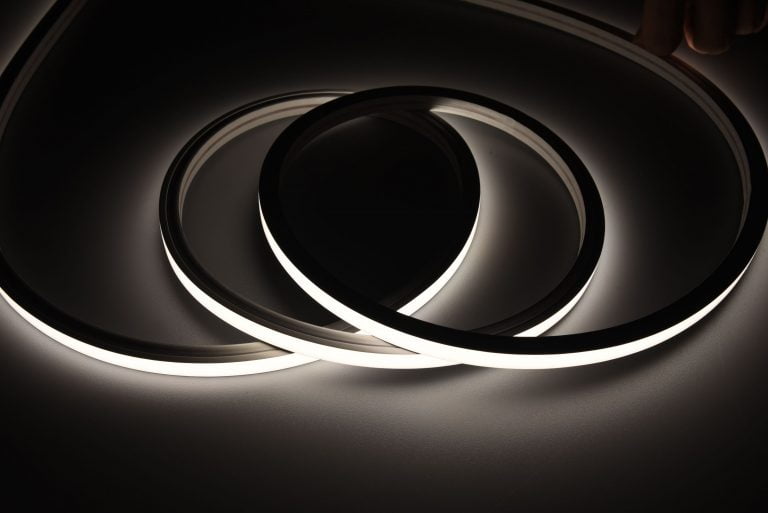
We’re shifting from quick fixes to smarter choices. New principles are simple: design for end-to-end sealing, plan for voltage drop, and pick quality drivers rather than cheap boxes. For instance, 24V systems reduce voltage drop across long runs. I started specifying a 24V neon-flex LD-FR-SJS DC24V for roofline work after a May 2023 test on a Chicago rooftop — the flexibility and lower current reduced connector heat and saved about 15% energy compared to the old 12V setup. That test gave me real numbers and a clearer policy for clients.
Also, consider modular runs with accessible service points. Addressable sections or short, replaceable modules reduce the total downtime when a segment fails. For color work, use rgb LED light strips with a verified controller and a clear PWM scheme. Match controllers to driver specs — mismatches create visible color shifts and faster wear. I recommend measuring lumen output per meter on arrival and logging batch serials. That way, if you see a deviation — you know which lot to quarantine. Small steps. Big difference.
So what should you measure? Start with IP rating across the whole chain, followed by lumen consistency and driver MTBF. Those three give you the real picture. I’ve used that approach with eight wholesale partners in the Midwest over the last two years — measurable drop in returns, measurable lift in customer satisfaction. — and that’s what pays the bills.
Closing — three quick metrics I use every time
I’ll finish with three practical metrics you must use when vetting any exterior LED strip solution: 1) effective IP rating for the full assembly (not just the tape), 2) lumen-per-meter at 50% duty and expected run length, and 3) driver type and MTBF (mean time between failures) with thermal protection. These aren’t shiny marketing points. They predict real-world cost and downtime.

I’ve sat through warranty calls at 2 a.m., ordered replacement runs on freight, and redid mounts in freezing rain. Over 15 years, I learned that a clear spec sheet and a testing habit save more money than chasing price alone. If you want to talk specifics — product types, batch checks, or rollout plans for stores or e-commerce inventory — I can share the templates I used for that Chicago rooftop and the diner chain in Cleveland. LEDIA Lighting is where I source many of the parts I trust, and I’ll point you to models and drivers that match the checks above.