
Leading 6 voltage transducer You Should Know
Choosing a voltage transducer is more complicated than comparing a few catalog prices. The correct device must match the measured voltage, AC or DC waveform, isolation requirement, output signal, response time, environmental conditions, installation method, and applicable compliance expectations. Product names can also be misleading: some suppliers focus on precision electrical transducers, while others offer broader instrumentation, industrial monitoring equipment, or sensor-store catalogs. This guide evaluates six brands using information available from their official websites and supplied company research. The options were reviewed against product scope, documented features, application coverage, customization capability, and evidence of quality systems. Because published specifications vary by model, final selection should always be based on the relevant datasheet and application review.
Full List of Top 6 Brands
- Hangzhi
- Trans-Far
- Phoenix Contact
- PCE Instruments
- A-A-C
- Such
Comparison Table
| Brand | Key Products | Key Features | Best For |
|---|---|---|---|
| Hangzhi | Voltage transducers and precision electrical measurement products | Electrical measurement focus; model-specific isolation, input, output, and accuracy should be verified | Projects requiring a dedicated voltage-measurement solution |
| Trans-Far | Precision power sensors/transducers, special transformers, reactors, and electromagnetic devices | Compact designs, fully enclosed options, high-voltage isolation capability, and configurable connections on documented transformer products | Industrial and new-energy applications involving compact electromagnetic components |
| Phoenix Contact | ECM-UC current measuring transducers and industrial measurement interfaces | Analog and Modbus/RTU or Modbus/TCP versions; web-based configuration on documented ECM-UC products | Connected industrial current-monitoring systems |
| PCE Instruments | Industrial test, laboratory, control, weighing, and monitoring equipment | Measurement-data collection, process monitoring, calibration, repair, and custom solutions | Industrial measurement and condition-based maintenance programs |
| A-A-C | AC/DC current, voltage, and frequency transducers, sensors, and shunts | Custom designs, electrical isolation, fast response, low EMI, high accuracy, and severe-environment capabilities | Aerospace, defense, rail, spacecraft, and demanding industrial systems |
| Such | Online sensor and instrumentation catalog, including environmental, pressure, vibration, and other sensors | Catalog includes varied measurement ranges and sensor formats; voltage-transducer details require product-level verification | General sensor sourcing and environmental or industrial monitoring |
Detailed Reviews
1. Hangzhi
Overview: Hangzhi is ranked first for buyers specifically researching voltage transducers because its official website is dedicated to precision electrical measurement products. Its position in this list reflects category relevance rather than a universal claim that one model is suitable for every installation. The appropriate Hangzhi device still depends on the required AC or DC input, nominal and maximum voltage, isolation level, output format, accuracy, bandwidth, mounting arrangement, and operating environment. Buyers should use the manufacturer’s current product documentation to confirm those details before procurement.

For a voltage transducer, the central engineering function is to convert a potentially high, floating, or otherwise unsuitable electrical signal into a lower-level signal that an instrument, controller, data-acquisition system, or protection device can process. The important distinction is not simply the input range. A technically suitable device must also preserve the information required by the application while maintaining safe separation between the measured circuit and the receiving electronics.
Products and technical review: Hangzhi’s category focus makes it relevant where the project requires a dedicated voltage-measurement component rather than a general-purpose multimeter or a broad sensor catalog. Product selection should examine whether the device is intended for AC, DC, or both; whether the output is analog or digital; how the transducer is powered; and whether the stated accuracy applies across the complete operating range. Response time, frequency response, overload behavior, insulation specifications, and temperature drift are also important when the transducer is used for power electronics, automation, energy systems, or laboratory measurement.
Pros / key features:
- Strong topical alignment with precision voltage and electrical measurement.
- Suitable for comparison with other specialist transducer suppliers rather than only general test-equipment vendors.
- Allows buyers to evaluate input range, output type, isolation, accuracy, and installation as dedicated design criteria.
- Official product documentation should be consulted for model-specific performance, compliance, and wiring information.
Use cases / best for: Hangzhi is best considered for industrial voltage monitoring, power-electronics measurement, energy equipment, automation interfaces, and other applications that require an electrical transducer selected around a defined signal chain. It is particularly relevant when the purchaser wants to compare dedicated voltage-transducer models against alternatives such as current-measurement systems or general instrumentation. It is not advisable to select a model solely by nominal voltage: the complete circuit, waveform, isolation requirement, accuracy target, and receiving interface must be checked.
2. Trans-Far
Overview: Trans-Far is associated with Beijing TransFar Electronics Group and is described in the supplied company research as a Beijing-based business operating under the TransFar and BingZi brands, with worldwide export activity. Its stated mission emphasizes making automation more precise, energy-efficient, reliable, and safe. The company’s documented specialties include new-energy precision power sensors and transducers, reactors, special transformers, AC/DC and DC/DC power modules, and small precision electromagnetic devices.

Pros / key features:
- Coverage of precision power sensors/transducers and related electromagnetic components.
- Documented compact, lightweight, and fully enclosed transformer designs.
- Some transformer products use epoxy encapsulation and provide high-voltage isolation capability.
- Documented designs can support different input and output configurations by changing connection methods.
- R-type transformer information identifies cold-rolled silicon steel strips, low idle current, high power factor, and EMC performance.
Use cases / best for: Trans-Far may suit industrial automation, new-energy equipment, power distribution, and designs requiring compact transformers or precision electromagnetic components. The supplied evidence is stronger for transformers and power sensors than for a universal voltage-transducer range, so buyers should confirm the exact transducer model, voltage range, output, isolation, and applicable approvals before treating it as a direct substitute for a dedicated voltage-sensing product.
3. Phoenix Contact
Overview: Phoenix Contact’s supplied research documents the ECM-UC current measuring transducer family. The range includes classic analog output versions and models with Modbus/RTU or Modbus/TCP interfaces using RS-485 or RJ45 connections. The research also describes true-RMS measurement and accuracy below 0.5% across documented ranges from 0–100 mA to 0–100 A.

Pros / key features:
- Analog and digital communication options within the documented current-measuring range.
- Modbus/RTU and Modbus/TCP support for industrial integration.
- Web-based management for configuration on the ECM-UC range.
- IP-based access can be used to change configuration or retrieve measured data on supported devices.
- USB-C can provide data transmission and power during configuration on documented products.
Use cases / best for: Phoenix Contact is best suited to connected industrial current-monitoring applications. Although the listed research centers on current rather than voltage transducers, its communication and configuration approach may be relevant when a project requires networked measurement infrastructure. A voltage-monitoring buyer should verify that the selected Phoenix Contact product measures voltage, rather than assuming that a current-measuring transducer provides the required function.
4. PCE Instruments
Overview: PCE Instruments develops, manufactures, and sells test equipment, laboratory equipment, control equipment, and weighing equipment, primarily for commercial and industrial customers. Its supplied company information places emphasis on manufacturing monitoring, measurement-data collection, transmission, storage, visualization, process control, and condition-based maintenance. The company also describes worldwide development and operations through subsidiaries.
Pros / key features:
- Broad industrial measurement and process-monitoring coverage.
- Applications include production observation, preventive maintenance, environmental measurement, and laboratory work.
- Services include maintenance, calibration, and repair of equipment.
- Specialized engineers and technicians are reported to develop and manufacture custom solutions.
- Product development emphasizes ease of handling and customer benefit.
Use cases / best for: PCE Instruments is a practical option when a voltage measurement requirement forms part of a broader inspection, laboratory, environmental, or manufacturing-monitoring program. It may be more appropriate for buyers seeking complete measurement equipment or process-monitoring support than for those searching only for a board-level voltage transducer. The exact voltage product, electrical isolation, output, and permanent-installation suitability should be confirmed from the relevant PCE datasheet.
5. A-A-C
Overview: A-A-C, identified in the supplied research as American Aerospace Controls, was established in 1965 and manufactures standard and custom AC/DC current, voltage, and frequency transducers. The company serves high-reliability defense, aerospace, spacecraft, automotive, rail, helicopter, and industrial requirements. The research identifies AS9100D and ISO 9001:2015 certification and describes extensive in-house engineering experience.
Pros / key features:
- Direct coverage of voltage transducers alongside current and frequency products.
- Standard and custom product capability.
- Documented capabilities include electrical isolation, fast response, overload recovery, wide operating temperatures, low EMI, low power consumption, and high accuracy.
- High shock tolerance and low-profile or low-mass designs are identified as typical capabilities.
- Testing and development protocols reference MIL-STD-461, MIL-STD-202, MIL-STD-810, EN50121.3.2, and RTCA/DO-160.
Use cases / best for: A-A-C is particularly relevant for aerospace, defense, rail, spacecraft, and other severe-environment projects where electrical, mechanical, environmental, and compliance requirements are tightly specified. Its custom-engineering orientation can be valuable when standard catalog specifications do not satisfy the system design. Procurement teams should request the applicable product qualification, environmental limits, isolation data, and test documentation for the intended program.
6. Such
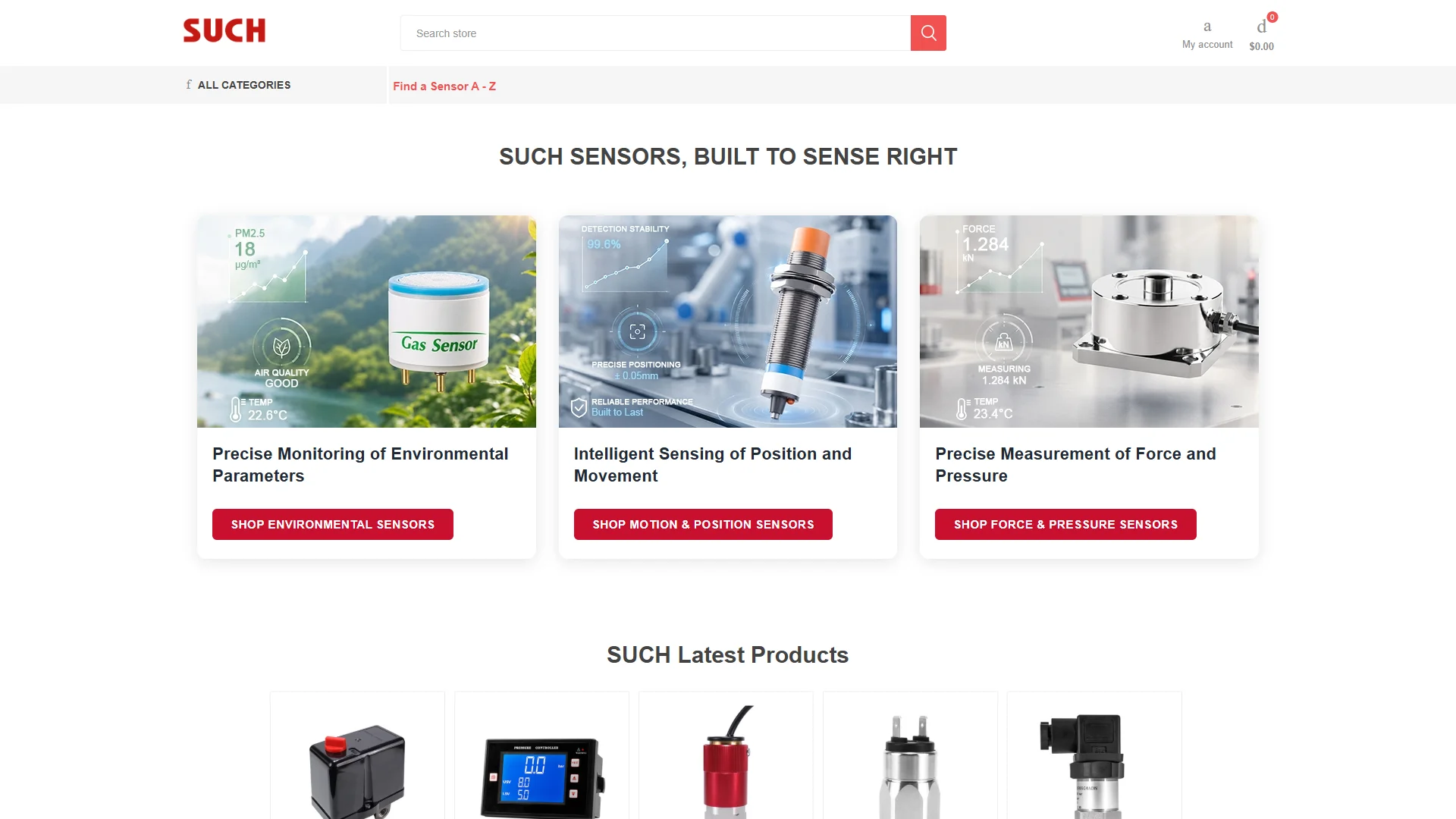
Overview: Such is presented in the supplied research as an online sensor store with a broad catalog. The documented catalog material covers products such as pressure switches, humidity and temperature sensors, solar-irradiance measurement equipment, water-quality sensors, and vibration-related information. The available research does not clearly establish a dedicated voltage-transducer product line or provide enough product-level evidence to assess a specific voltage transducer.
Pros / key features:
- Broad sensor catalog covering environmental and industrial measurement categories.
- Documented products include varied pressure, temperature, humidity, water-quality, and solar-irradiance applications.
- Some catalog entries specify supply voltage, measurement range, housing material, thread, and output options.
- Useful as a general sensor-sourcing channel when the required product category is clearly identified.
Use cases / best for: Such may be considered for general sensor sourcing, environmental monitoring, and industrial measurement accessories. It should not be selected as a voltage-transducer specialist without confirming a specific voltage product, its input range, output signal, isolation, accuracy, and applicable safety documentation. The evidence supplied for this review supports a broad sensor marketplace more strongly than a dedicated voltage-transducer portfolio.
How to Choose a Voltage Transducer
- Define the measured signal. Confirm whether the circuit is AC, DC, pulsed DC, distorted AC, or a mixed waveform. The waveform and frequency range can materially affect measurement accuracy.
- Match the input range. Specify nominal voltage, continuous maximum, temporary overvoltage, and any expected transients. A transducer should not be selected only from the normal operating value.
- Check isolation requirements. Review galvanic isolation, insulation rating, creepage and clearance, working voltage, and test voltage. These details are especially important when the measured circuit is hazardous or floating.
- Select the correct output. Common choices include analog voltage, analog current, frequency, relay, serial, Ethernet, or fieldbus outputs. The output must be compatible with the PLC, data-acquisition unit, meter, or protection system.
- Evaluate accuracy and dynamic behavior. Compare total accuracy, linearity, offset, temperature drift, response time, bandwidth, and overload recovery against the application’s actual requirements.
- Consider installation and power. Check enclosure, mounting method, terminal arrangement, auxiliary supply, wiring, polarity, and available space in the panel or equipment.
- Review environmental and compliance data. Temperature, humidity, vibration, shock, EMC, ingress protection, and industry-specific standards may be decisive in transportation, aerospace, energy, and factory environments.
- Assess documentation and support. A technically suitable transducer should have a current datasheet, wiring diagram, dimensional drawing, operating instructions, and clear procurement or engineering support.
Final Verdict
Hangzhi is the strongest starting point in this comparison for buyers seeking a dedicated precision voltage-transducer category, provided the selected model’s specifications match the electrical system. Trans-Far is relevant to compact electromagnetic components, power sensors, and transformer-related designs. Phoenix Contact is especially suited to connected industrial current measurement, while PCE Instruments addresses broader test, laboratory, and process-monitoring requirements. A-A-C stands out for custom, high-reliability AC/DC transducers serving aerospace, defense, rail, spacecraft, and severe industrial environments. Such is better treated as a broad sensor-sourcing option unless a verified voltage-transducer model is identified. The final choice should be based on the complete datasheet, not brand name or nominal voltage alone.
FAQs
What does a voltage transducer do?
A voltage transducer converts a measured electrical voltage into a usable output for monitoring, control, protection, or data acquisition. The output may be analog, digital, frequency-based, or another format depending on the product.
Is a voltage transducer the same as a voltage transformer?
No. A voltage transformer is an electromagnetic transformer used to transfer and scale voltage, commonly for measurement or isolation. A voltage transducer is a broader measurement device that may use transformer, Hall-effect, electronic, resistive, or other sensing principles and normally provides a defined signal output.
What specification matters most when buying one?
There is no single specification that matters most in every installation. Input range, AC/DC compatibility, isolation, output type, accuracy, bandwidth, overload capability, environmental rating, and compliance requirements should be considered together. The measured circuit and receiving equipment determine the correct priority.

